
You opened your second location thinking the hard part was behind you. Then came the scheduling conflicts you didn't catch until Monday morning, the payroll run that took three hours longer because the time cards from location two were still on paper, and the team message that only half your team saw because it got buried in a personal group chat.
Managing a franchise means managing everything: every location, every shift, every pay period. The right franchise software keeps all of it connected so you're not the missing link between your own locations.
But "franchise software" isn't one thing. It covers tools built for selling franchise territories, tools built for running daily team operations, and tools built for everything in between. Picking the wrong one for your situation just adds a new problem. As franchise operators discuss in Reddit's "Best CRM for Franchise?" thread, managing customer relationships and gaining network-wide visibility across franchise locations are two different jobs that often require different tools.
This guide covers what franchise management software actually does, how to evaluate it, and which five tools are worth your time in 2026.
Quick Answer: The Best Franchise Software in 2026
If you're short on time, here's where each tool lands:
- Connecteam: Best for mobile-first franchise teams and field-based operations
- Delightree: Best for fast-scaling franchises focused on SOP compliance and standardization
- Erply: Best for inventory-heavy franchises with complex retail POS needs
- Pulse: Best for franchise development and sales analytics
- FranConnect: Best for large, established franchise brands needing enterprise management
Want the full breakdown, including pricing and what real users say? Keep reading.
Why Trust Homebase? Why We Built This Guide
We're Homebase, and we make a scheduling, time tracking, payroll, and HR app for small businesses with hourly teams. We have a stake in this topic, so we want to be upfront: Homebase is not in the ranked list below, and every app was evaluated on its own merits. We never accept payment or backlinks for a product mention.
Homebase is an app for hourly teams that handles scheduling, time tracking, payroll, hiring, and HR in one place, built for small businesses in restaurants, retail, gyms, and service industries. We built this guide because our customers frequently ask us how franchise software compares, and they deserve a straight answer even when that answer isn't us.
How We Chose the Best Franchise Software
We evaluated tools across six criteria: multi-location scheduling, time tracking accuracy, payroll integration, FLSA and state compliance, mobile accessibility, and pricing transparency. Ratings were verified against each product's current live review listings on G2 and Capterra where available; where a product wasn't listed, we note that rather than substitute ratings from another review site. Pricing was checked against each vendor's live page. No vendor paid for placement. Full process: methodology page.
What Is Franchise Software?
Franchise software is a category of business tools designed to help franchise owners manage operations, teams, and compliance across multiple locations. Depending on which type you choose, it covers everything from employee scheduling and payroll to franchise sales pipelines and territory mapping.
Two franchise owners searching for the same term might need completely different things: one needs to manage hourly employees across five locations, and the other needs to recruit new franchisees. The tools built for each problem don't overlap much.
For most small franchise owners in restaurants, retail, gyms, and salons, the relevant category is franchise operations software: scheduling, time tracking, payroll, and compliance. It doesn't handle accounting, inventory, or point-of-sale natively, though good operations tools integrate with all three.
Types of Franchise Software (And Which One You Actually Need)
Franchise operations software
Franchise operations software handles day-to-day team management at each location (the work that happens after someone becomes a franchisee). It covers employee scheduling across multiple locations, time tracking and attendance, payroll processing, HR compliance, and team communication.
Best for: Franchises with hourly teams: restaurants, gyms, retail, salons, cleaning services, and home services.
If your biggest headaches are scheduling conflicts, messy time cards, and payroll prep that takes longer than it should, this is the category you need. It does not handle territory mapping, franchise recruitment, or franchise disclosure document delivery.
Franchise development and CRM software
Franchise development software focuses on selling franchises and managing the franchisee recruitment pipeline. This covers lead management, territory mapping, candidate tracking through the sales process, FDD delivery, and e-signatures on franchise agreements.
Best for: Franchisors actively recruiting new franchise owners and growing their network. Tools in this category include FranConnect, FranFunnel, and ClientTether.
Several franchise operators in Reddit's "Franchise CRM Recommendations (B2C)" thread describe needing HQ dashboards, separate franchisee data, and location-level reporting before anything else. The shift toward purpose-built franchise tools happens because multi-location data hierarchy becomes difficult to maintain in generic CRMs as brands scale. Some franchisors say they prefer a system that supports franchise structures without extensive customization.
Franchise training and onboarding software
Training and onboarding software helps get new franchisees and their teams up to speed on brand standards, SOPs, and compliance. It covers learning management systems, digital onboarding workflows, and certification tracking.
Best for: Growing franchises needing consistent training across locations. Delightree falls into this category; some operations tools include basic employee onboarding alongside scheduling.
Which type do you need?
- Managing hourly employees day-to-day across your locations → operations software
- Selling new franchise territories and growing your network → development/CRM software
- Standardizing training and SOPs across existing locations → training software
Many franchises use more than one: an operations tool for franchisees, a development tool for growth.
What Features Should Franchise Software Have?
Not every tool does all of this well. Here's what to look for, and what breaks when it's missing.
Employee scheduling across multiple locations
Good franchise scheduling software lets you build a template once and replicate it across locations. It should support drag-and-drop scheduling from a mobile device, open shift posting for employees to claim, shift trading with manager approval, automatic conflict detection, and instant schedule publishing with text and email notifications.
What breaks without it: you rebuild every location's schedule from scratch each week, and your team still shows up uninformed. Tools that auto-populate from templates and flag conflicts before you publish cut that time to minutes.
Time tracking and attendance management
In your franchise management software, look for mobile clock-in, GPS location verification for each franchise location, photo capture to prevent buddy punching, automatic break tracking with compliance alerts, and digital timesheets that sync directly to payroll.
What breaks without it: paper time cards, time theft you can't catch, manual math before every payroll run. One Homebase customer put it plainly: "Before Homebase I was manually tallying up my team's work hours and entering them into payroll, crossing my fingers I hadn't made any mistakes. Now our entire team logs in and out quickly and easily with the Homebase app, and all I have to do is send their hours to my payroll program with the click of a button."
Payroll integration for franchises
Strong payroll integration means one-click timesheet-to-payroll export, automatic overtime and wage calculations, payroll calculations and tax administration across supported federal, state, and local jurisdictions, direct deposit processing, and clean integrations with QuickBooks, Gusto, or Square Payroll (or a native payroll option built in).
What breaks without it: manual re-entry is where errors live, and operating across state lines compounds the problem. Minimum wage rates, overtime thresholds, and break requirements vary by jurisdiction. The Fair Labor Standards Act establishes federal minimum-wage, overtime, and recordkeeping requirements for covered employers and employees. "The seamless way the data goes over to QuickBooks and I can run payroll with a couple button clicks is great," said one Homebase customer.
HR compliance and labor law management
Multi-location franchise operations mean multiple sets of rules. Good compliance tools configure state and local break and overtime rules per location automatically, surface alerts before employees hit thresholds, and store digital records with audit trails for FLSA compliance. The Fair Labor Standards Act, enforced by the U.S. Department of Labor, establishes federal minimum-wage, overtime, and recordkeeping requirements for covered employers and employees. Getting it wrong across multiple states carries real financial exposure.
Labor cost reporting and visibility
Real-time labor cost analysis by location, department, and role (compared against actual sales) is what separates guessing from managing. The best tools integrate with your POS system so you're scheduling against real revenue data. Tools like Homebase connect labor cost tracking directly to your schedule so you see the impact before the schedule is published.
Comparison: Top 3 Franchise Software Tools
Connecteam
- Best for: Mobile-first hourly teams
- Starting price: Free for up to 10 users; Operations Hub from $29/month for up to 30 users (annual billing)
- Free tier: Yes, permanent Small Business Plan for up to 10 users
- Key integrations: Gusto, QuickBooks, Paychex, Xero
- G2: 4.6 · Capterra: 4.6
Delightree
- Best for: Franchise SOP compliance and operations standardization
- Starting price: Custom, per-location pricing based on network size
- Free tier: No publicly advertised free plan
- Key integrations: API or integration availability requires vendor confirmation
- G2: 4.6
Erply
- Best for: Inventory-heavy retail franchises
- Starting price: Contact vendor for current pricing
- Free tier: Free trial available; no permanent free plan confirmed
- Key integrations: QuickBooks, Shopify, WooCommerce, NetSuite, Adyen
- Capterra: 4.2
How Homebase Compares
Publisher note: Homebase is not in the ranked list above.
- Best for: Restaurants, retail, gyms, salons, and service franchises managing hourly teams
- Starting price: Free for one location and up to 10 employees; paid plans start at $30/location/month, or $24/location/month billed annually
- Free tier: Yes, Basic plan for one location with up to 10 employees
- Key integrations: QuickBooks Online Plus, Gusto, Square, Toast, Clover, ADP
- G2: 4.6 · Capterra: 4.6
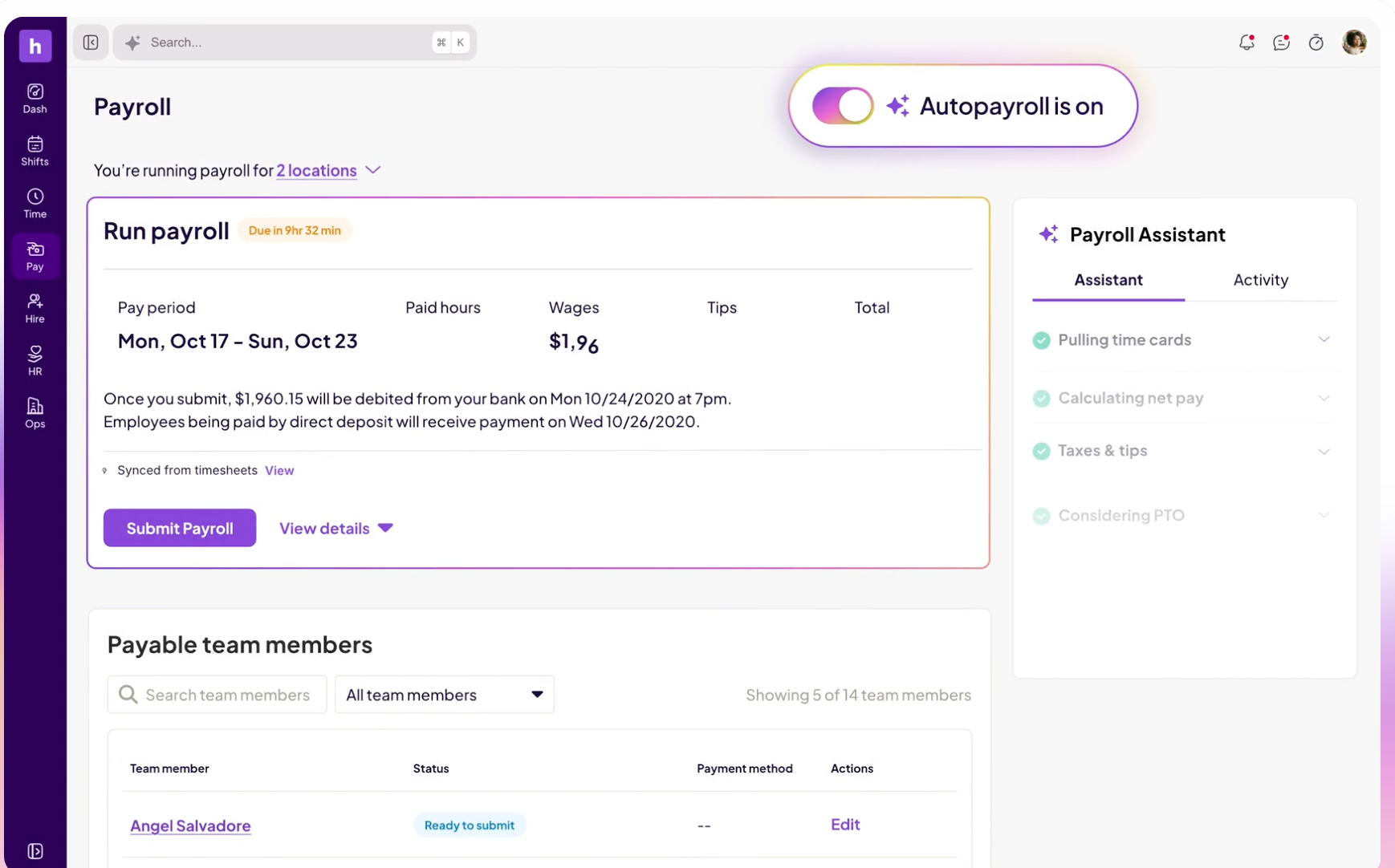
Homebase is best suited to franchises whose primary challenge is managing hourly employees rather than selling or administering franchise territories. Scheduling, time tracking, payroll, and compliance connect in one workflow. Timesheets sync directly to payroll without re-entry, overtime is flagged before it hits, and every location's hours flow into the same system. Get started free.
The 5 Best Franchise Software Tools in 2026
1. Connecteam
Best for: Mobile-first franchise teams and field-based operations
Rating: G2 [4.6] · Capterra [4.6] (G2 · Capterra)
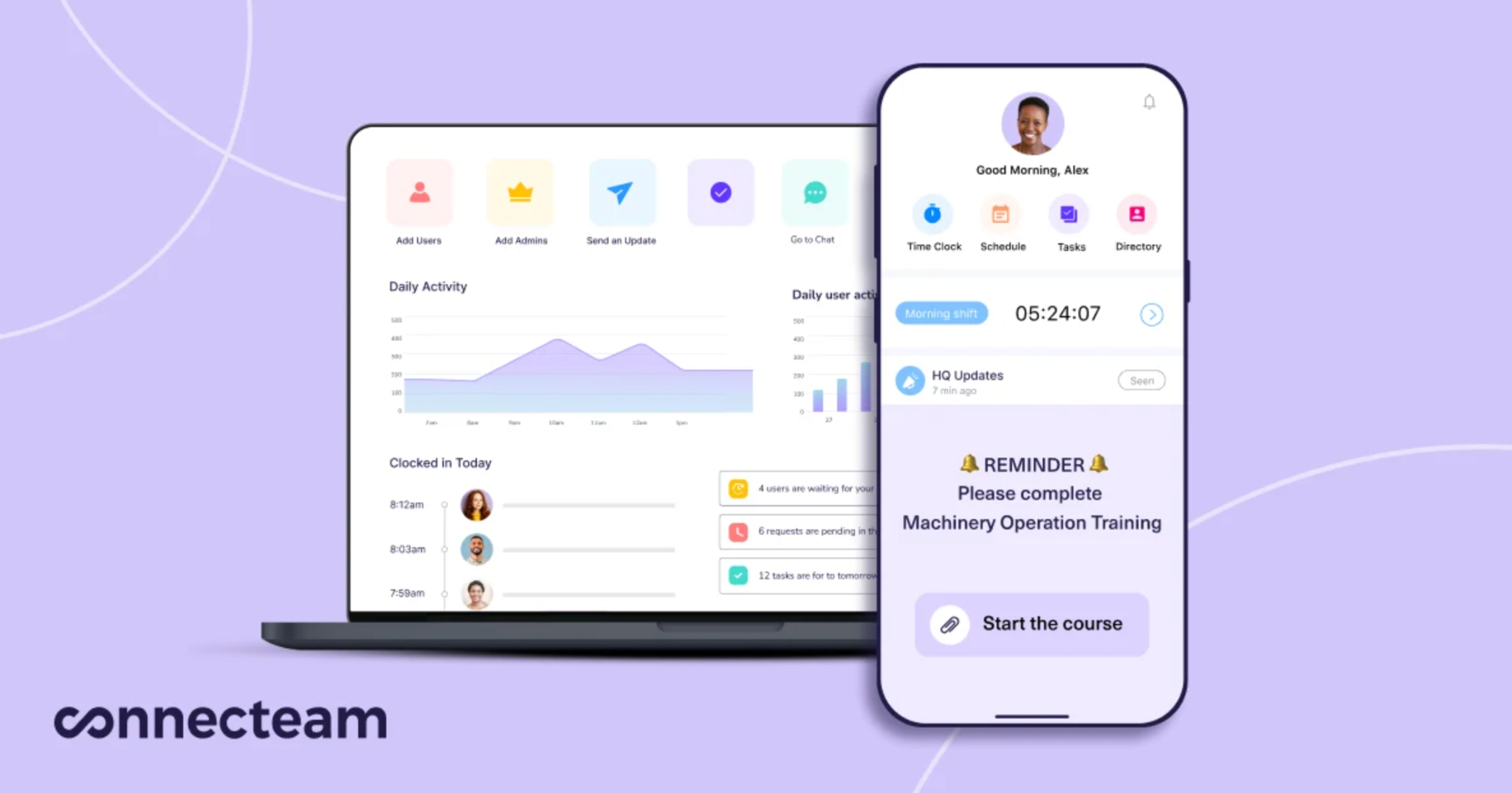
Connecteam is a mobile-first app built for hourly and deskless teams. It covers employee scheduling, time tracking, team communication, checklists, forms, and courses across its Operations, Communications, and HR & Skills hubs.
Key features:
- Mobile scheduling with open shift claiming and shift swaps
- Built-in team chat by location or group
- Checklists, forms, tasks, and courses across Operations and HR hubs
- Time clock with GPS tracking and geofencing
Pricing: Free permanent Small Business Plan for up to 10 users; active and archived users both count toward the cap. The plan includes scheduling, time tracking, GPS, and geofencing. Paid plans are priced separately by hub. The Operations Hub starts at $29 per month for up to 30 users with annual billing, or $35 with monthly billing. See connecteam.com/pricing for current rates.
What users like: G2 reviewers frequently mention ease of use and the convenience of having scheduling, time tracking, and team communication in one place. (G2)
What users criticize: Some G2 reviewers mention wanting more advanced reporting and additional integrations, particularly as organizations grow. (G2)
Our take: Connecteam is a strong option for franchises where mobile accessibility and communication are the priority. Several discussions in Reddit's r/CRM community distinguish employee scheduling software from franchise management software, noting that scheduling tools solve a different problem than franchise CRM tools. (Reddit r/CRM) Connecteam is strongest when scheduling and communication are your core bottlenecks. If you need deep labor cost analytics or multi-state payroll compliance, you'll outgrow it.
2. Delightree
Best for: Fast-scaling franchises focused on SOP compliance and operations standardization
Rating: G2 [4.6]
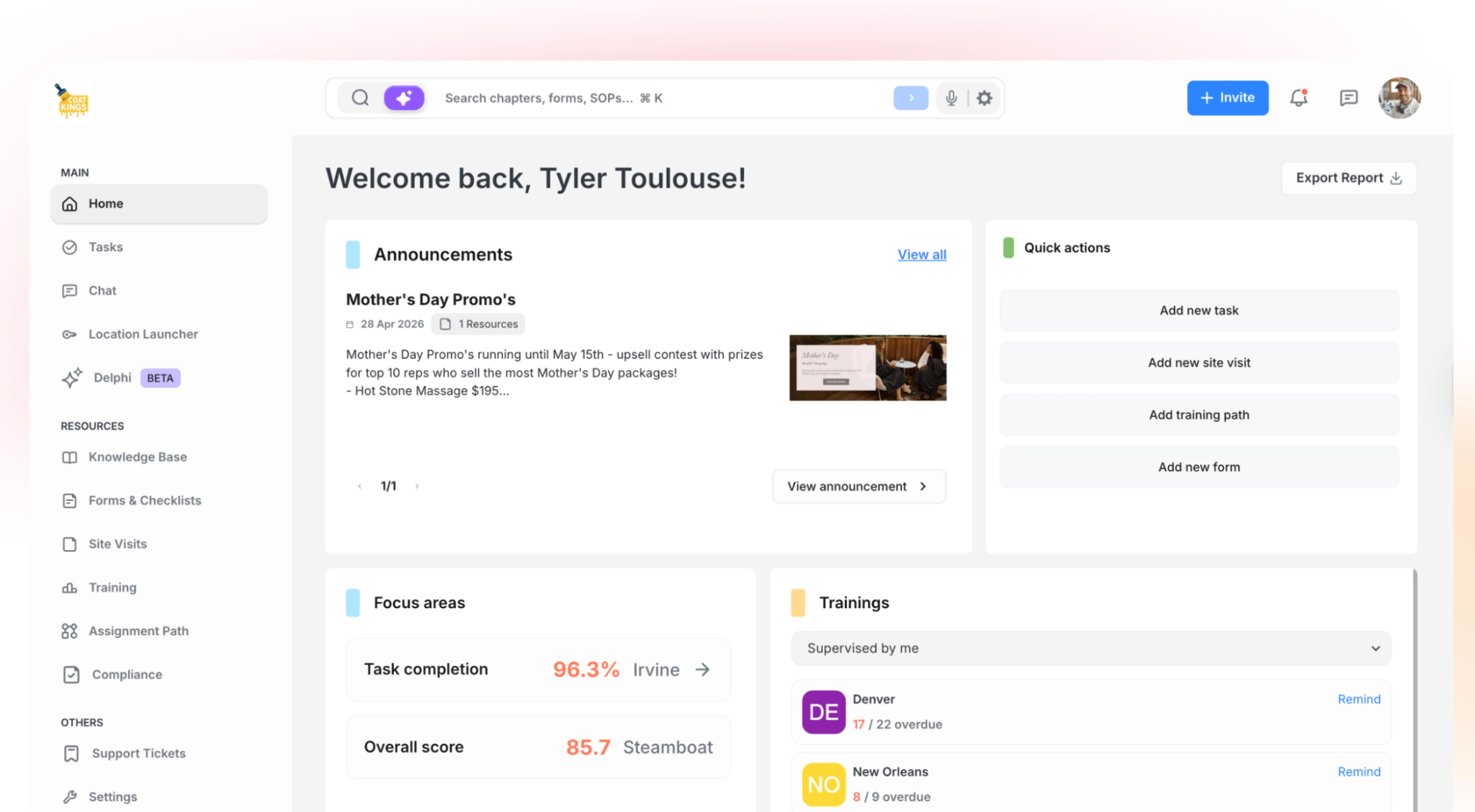
Delightree is a franchise operations app built around standardization: SOP and operating-content management, training, audits, and task management, designed to ensure every location runs the same playbook.
Key features:
- SOP and operating-content management
- Training and franchisee onboarding workflows, and repeatable location-launch playbooks
- Audits with corrective actions and tracked resolution
- Task management and role-based visibility across HQ and franchise locations
Pricing: Custom, flat per-location pricing based on network size and enabled capabilities. No publicly advertised free plan. Contact via delightree.com/pricing.
What users like: Delightree customer materials emphasize standardized operating procedures, franchisee onboarding, training, audits, and location-launch workflows. (Customer stories, Delightree)
What users criticize: Delightree focuses on franchise execution, training, audits, and task management rather than employee scheduling or payroll. Smaller operators may find its franchise-wide workflow capabilities broader than they need.
Our take: Delightree solves operational consistency well: SOPs, training, and compliance documentation in one place. Growing brands typically pair it with a dedicated CRM, since documentation and operations don't replace franchise sales management. It's not a substitute for scheduling and payroll.
3. Erply
Best for: Inventory-heavy franchises with complex retail POS needs
Rating: Capterra [4.2]
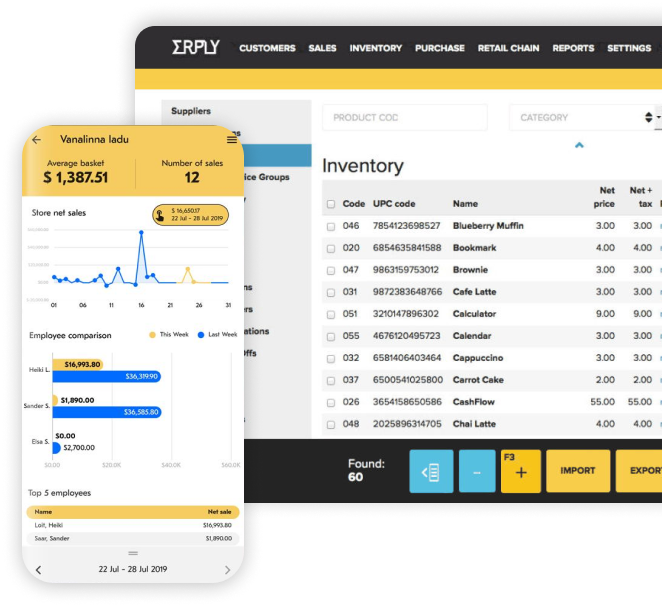
Erply is a cloud-based point-of-sale and inventory management system for multi-location retail businesses, with real-time inventory tracking, unified sales data, and configurable workflows across locations.
Key features:
- Real-time inventory tracking across all locations
- Scalable multi-location POS system
- Unified sales reporting and analytics
- Configurable workflows, employee management, and multi-store controls
- Integrations with QuickBooks, Shopify, WooCommerce, NetSuite, and Adyen
Pricing: Contact Erply for current pricing. A free trial is advertised, although the stated trial length varies between official product pages. No permanent free plan was confirmed. See erply.com/erply-pricing for details.
What users like: Erply's public materials emphasize centralized inventory, multi-store controls, and unified retail reporting. (Customer stories, Erply)
What users criticize: Some Capterra reviewers report usability and implementation friction. Erply also focuses primarily on retail POS, inventory, and reporting rather than employee scheduling or team communication. (Capterra)
Our take: Erply stands out for retail franchises where inventory and point-of-sale are the core operational challenge. If your bottleneck is stock management, unified sales data, and POS consistency across locations, it's a strong fit. If your bottleneck is team scheduling and payroll, Erply isn't built for that.
4. Pulse
Best for: Franchise development and sales-focused organizations that need analytics and CRM
Rating: Capterra [4.4]
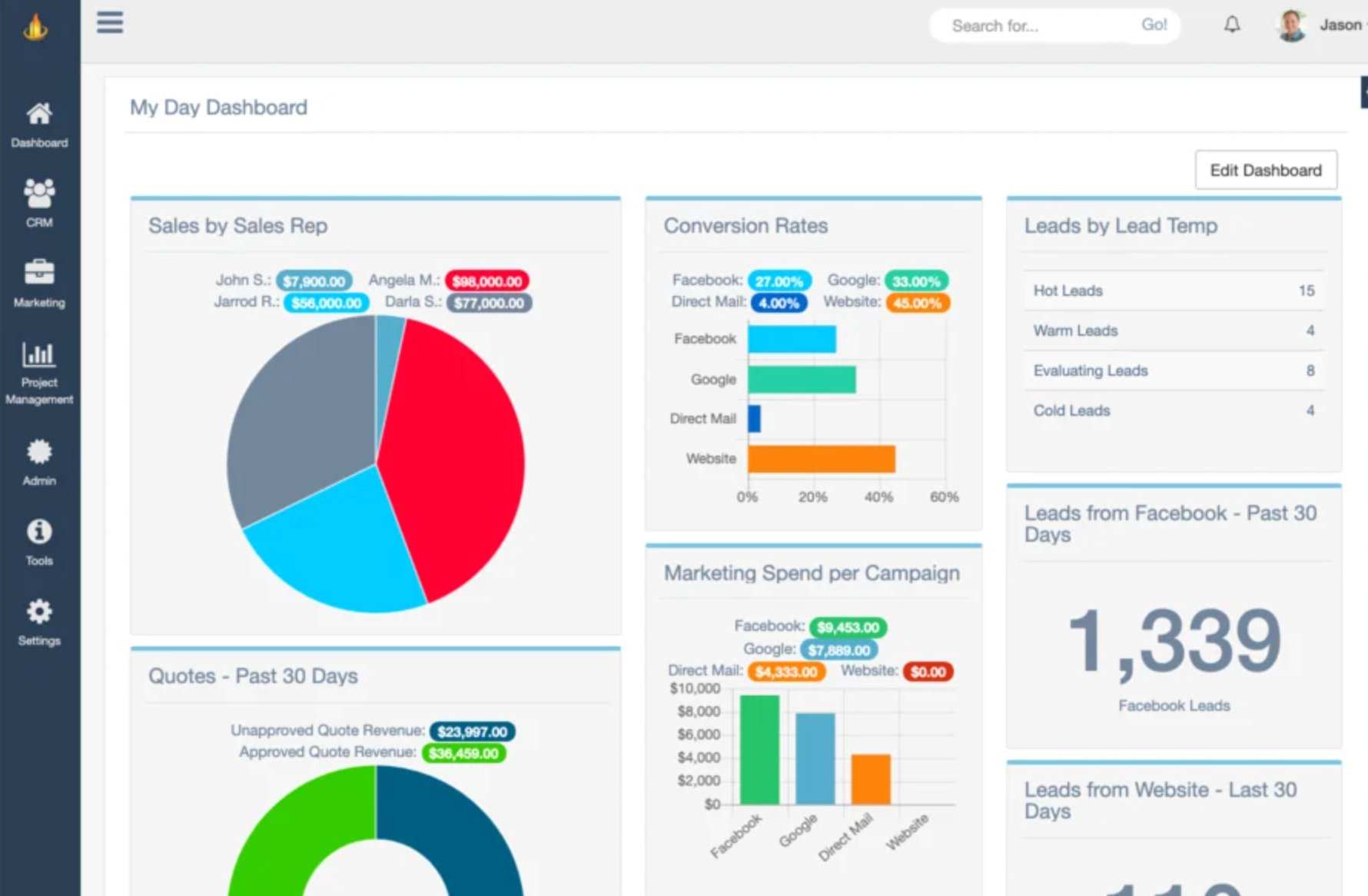
Pulse (by The Pulse Spot, at thepulsespot.com) is a CRM and analytics tool for franchise development teams, covering sales and marketing automation, lead and pipeline management, and real-time reporting across locations.
Key features:
- CRM for franchise sales pipeline and lead management
- Sales and marketing automation
- Shared dashboards and real-time reporting
- No-contract monthly billing
Pricing: Standard Pulse CRM plans start at $49 per month, but the vendor states that published plan prices do not include franchise-management features. Contact Pulse for franchise-specific pricing at thepulsespot.com/pulse-for-franchises.
What users like: Pulse's franchise materials emphasize lead management, automated follow-up, shared pipelines, and network-wide reporting. (Customer stories, Pulse)
What users criticize: Pulse has fewer independent reviews than the larger tools in this guide, which makes recurring customer-experience patterns harder to assess. It also does not replace employee scheduling, time tracking, or payroll software.
Our take: Pulse focuses on franchisors running an active development pipeline who need CRM and analytics together. It's not for the franchisee managing daily team ops: no scheduling, no time tracking, no payroll. If you're selling and growing your franchise network rather than running shifts, it's worth a look.
5. FranConnect
Best for: Large, established franchise brands needing an all-in-one enterprise management suite
Rating: Capterra [4.3]
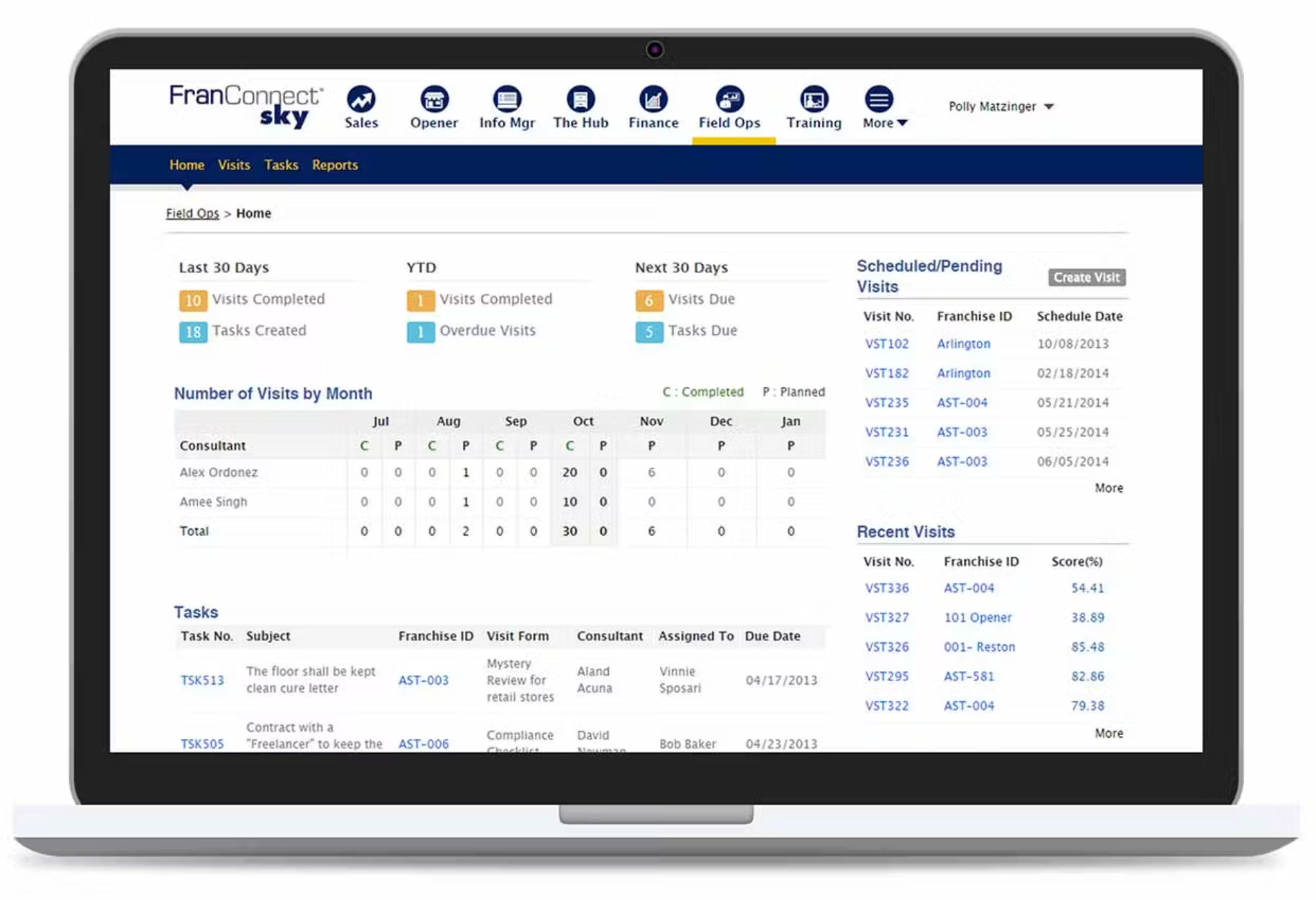
FranConnect is an enterprise franchise management tool covering franchise development, operations, compliance, field visits, marketing, and financial management, with AI-driven insights through Frannie AI.
Key features:
- AI-powered franchise-development CRM and sales pipeline
- Operations, field-visit, and compliance management
- Marketing and financial modules
- Analytics dashboards, scorecards, and benchmarks with Frannie AI insights
- FranConnect GO: a preconfigured package for emerging franchise brands, launched 2025
Pricing: Custom quote; no publicly stated free tier. Request pricing via franconnect.com.
What users like: "We use FranConnect to manage franchise development, franchise administration and compliance, and franchise operations. It is our single source of truth." (FranConnect customer story, FranConnect)
What users criticize: Some reviewers describe a significant implementation and learning curve. FranConnect's breadth is better aligned with established networks than with small franchise operators seeking a lightweight tool. (Capterra)
Our take: FranConnect is designed for organizations that need franchise-native architecture: hierarchy, HQ visibility, and network-wide reporting. Several discussions in Reddit's "CRM for Franchising" thread note that generic CRMs often require significant customization to support franchise hierarchies and parent-child account structures. That's the gap FranConnect is built to close. The trade-off is complexity. Right for 50+ locations with a dedicated ops team; likely overkill for a 3-to-10 location franchise.
Franchise Software for Your Industry
Different franchise types run into different operational challenges. Here's what to prioritize by vertical.
Restaurant and food service franchises
Restaurant franchises deal with rotating shifts, high turnover, tight margins, and strict compliance. The must-haves: rotating shift scheduling, break compliance for food service regulations, POS integration with Toast, Square, or Clover, labor cost tracking against sales targets, and tip management. Look for a tool that automatically applies the right break and overtime rules per location's state. FLSA and state-level tip credit rules add compliance complexity that basic scheduling tools often don't address.
Gym and fitness franchises
Fitness franchises juggle instructor scheduling, class coordination, and flexible part-timers across multiple pay rates. Priorities: multiple wage rates for different roles, mobile accessibility for non-desk team members, and accurate attendance tracking that connects to payroll.
Retail, salon, and service franchises
These franchises need shift coverage across locations, tip and commission tracking, and GPS verification for mobile service teams. The key differentiator: shift trading across locations and employee availability management across multiple stores.
Multi-industry franchise operators
If you operate different franchise types, prioritize a flexible operations tool over an industry-specific one. Configurable pay rates, compliance rules per location, and role-based scheduling are the features to evaluate.
Frequently Asked Questions About Franchise Software
What is franchise management software?
Franchise management software helps franchise owners and franchisors manage operations across multiple locations from one system. It covers employee scheduling, payroll, SOP compliance, and franchise development CRM, depending on which type you need. The right tool depends on whether you're managing daily team operations or growing your franchise network.
What software is best for managing daily operations at franchise locations?
For franchises with hourly employees, prioritize tools that handle employee scheduling, time tracking, and payroll together. Operations tools built for shift-based work, like Homebase, Connecteam, or Deputy, are better suited to daily franchise ops than enterprise tools designed for salaried organizations.
What is the difference between franchise software and a franchise CRM?
Franchise software covers both operations tools (scheduling, payroll, compliance) and development tools (sales pipeline, territory management). A franchise CRM focuses on managing franchise candidate relationships through the sales process. Most franchisees need operations software; franchisors growing their network need a CRM, or both. (Reddit discussion)
Can I run a franchise using HubSpot or Salesforce?
Yes, but franchise operators consistently report that generic CRMs require significant customization before they support franchise hierarchies and franchisee data separation. Purpose-built franchise tools are recommended once networks begin scaling because multi-location hierarchy is difficult to maintain in software not designed for it. (Reddit discussion)
When do I need franchise software instead of scheduling software?
If you're managing hourly employees day-to-day, scheduling and time tracking tools are likely enough. If you're a franchisor running recruitment, territory management, and network reporting, several Reddit discussions from franchise operators point toward purpose-built franchise tools over general scheduling tools alone. (Reddit discussion)
How much does franchise management software cost?
Operations tools for hourly teams range from free to $50 per location per month. Development and CRM tools run $50–$200 per user per month. Enterprise tools typically require custom pricing. Look for transparent per-location pricing without long-term contracts.
The Right Tool Keeps Every Location Running the Same Way
Franchise software isn't one purchase. It's a decision about which category of problem you're solving. Operations software runs the day-to-day. Development software grows the network. Training software keeps every location consistent. Many franchises need more than one, and the tools that solve each problem well are different.
For hourly franchise teams, the features that matter most are the connected ones: scheduling that flows into time tracking, time tracking that flows into payroll, payroll that handles multi-state compliance. When those three things live in separate tools, the gap between them is where errors and money disappear. If that's the problem, Homebase was built for it. Sign up free today.

Carissa is the SEO + GEO Managing Editor at Homebase, with 13 years of experience in content marketing and SEO strategy. She’s created foundational guides on starting a business, navigating payroll, and managing teams, and helped solo lawyers, artists, and creative entrepreneurs grow their web presence and organic traffic.

.webp)
Carissa is the SEO + GEO Managing Editor at Homebase, with 13 years of experience in content marketing and SEO strategy. She’s created foundational guides on starting a business, navigating payroll, and managing teams, and helped solo lawyers, artists, and creative entrepreneurs grow their web presence and organic traffic.
