
About the data: The Main Street Health Report is based on data from more than 100,000 small businesses and 2 million hourly employees who use Homebase.
June 2026
Smaller businesses faced economic hardship in 2023–2025 due to higher interest rates and tariffs. It was, unfortunately, correct to predict that the US labor market would get worse during that period. But halfway through 2026, there is a more optimistic story to tell these small businesses. Most of the labor market metrics that were deteriorating in the last few years are no longer getting worse, and a few are even improving.
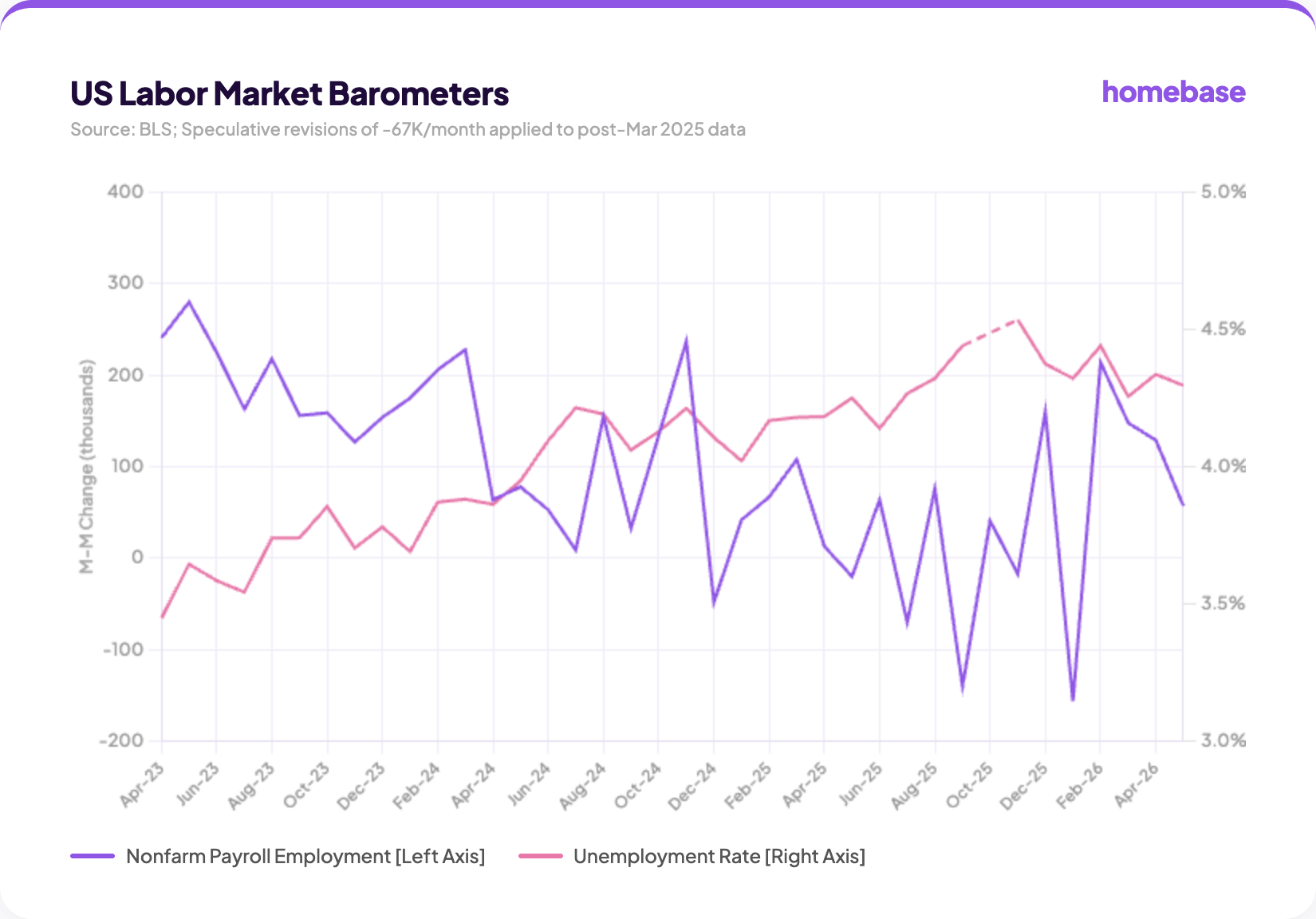
Earlier this month, we got the June jobs report. It wasn’t a great report; I wouldn’t even call it a good report. But it was OK, and capped off a decent first half. Employment growth averaged 92,000 per month; the unemployment rate fell from 4.4% to 4.2%. It’s nice to see things moving in the right direction, and I’m hoping that these positive developments continue.
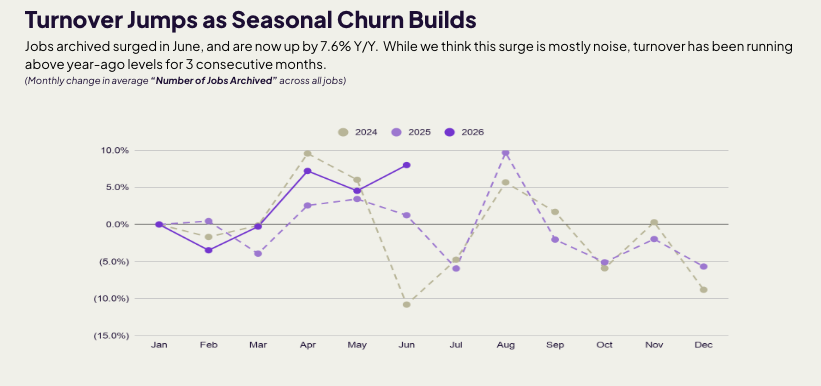
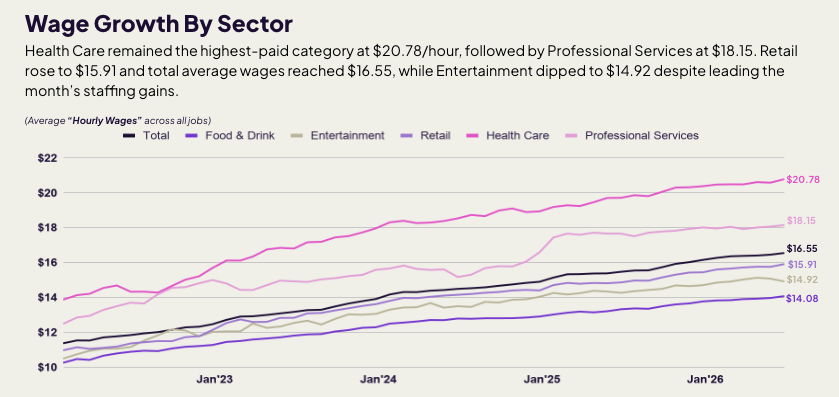
We’ve also seen stabilization across Homebase’s data, based on 100,000+ businesses and 2 million hourly employees active in the US on our platform. From 2023–25, businesses hiring on Homebase fell by an average of 4.5% per year, and turnover fell by 5.1% per year. Wage growth decelerated from 11.8% year-on-year in early 2023 to 7.5% by January 2026.
These aren’t the kind of stats you’d see when the labor market is getting better. When the job market cools, people have fewer outside opportunities (lower hiring); they’re less likely to leave for those opportunities (lower turnover); and they have less bargaining power when asking for a raise (lower wage growth).
But each of these indicators is improving, or getting closer to improvement. Hiring is down 2.8% Y/Y - not great, but falling more slowly; turnover is actually rising; and wages are growing at 7.0%, as deceleration has stopped.
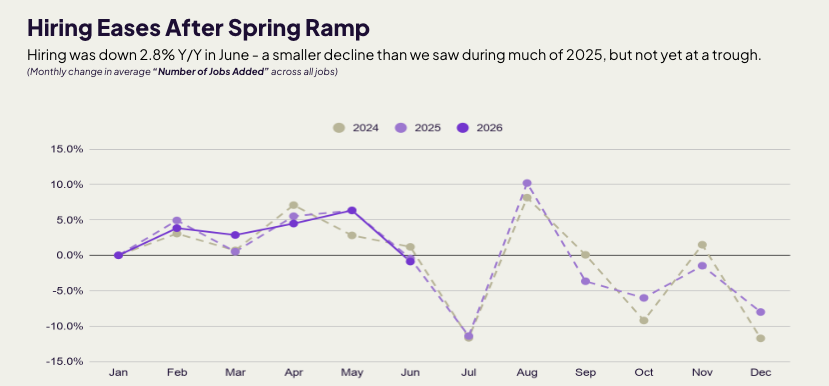
Of course the data wasn’t unanimous, either in the BLS data or Homebase. The BLS had a very large (though probably anomalous) decline in employment of 25- 34-year-olds. And until hiring starts rising again in Homebase’s data, I don’t think we can quite call it a labor market recovery. I’d caution that the situation is still fragile - it wouldn’t take a big deterioration in business sentiment for us to resume trending in the wrong direction. Cross your fingers!
Guy Berger is a macroeconomist specializing in US labor markets, passionate about helping small business owners understand what’s happening in the job market. He currently serves as Senior Advisor on Labor Markets at Access/Macro and Workforce Economist in Residence at Guild. Previously Principal Economist at LinkedIn, Guy's commentary has been featured in the New York Times, Wall Street Journal, and Bloomberg. He holds a doctorate in economics from Yale.

Guy Berger is a macroeconomist specializing in US labor markets, passionate about helping small business owners understand what’s happening in the job market. He currently serves as Senior Advisor on Labor Markets at Access/Macro and Workforce Economist in Residence at Guild. Previously Principal Economist at LinkedIn, Guy's commentary has been featured in the New York Times, Wall Street Journal, and Bloomberg. He holds a doctorate in economics from Yale.
